
Nプロジェクトが目指す未来2
The Future Envisioned by the N Project 2
科学を繋がりの拠点へ
Our future plans….to make science as hub for connections to manythins
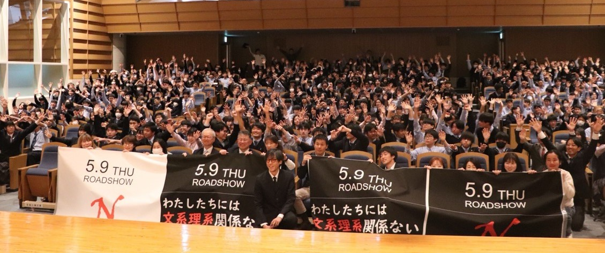
Nプロジェクトが目指す社会とは、科学的リテラシーが世代や属性を問わず共有され、対話・意思決定・協働の土台として機能する社会である。科学的リテラシーは、科学に関する専門知識の有無にかかわらず、自らの暮らしや社会課題と科学的視点を結びつけて考え、伝え、共に動いていく力である。本取組は、「事実に基づいて考え、論理的に結論を導く」という科学的考え方を多様なコミュニケーションの共通基盤とするという意味で「科学を世界の言語にする」という理念を掲げ、文理の枠を越えて科学による社会基盤構築に関する実践活動として展開してきた。
将来的には、科学の語り手が「専門家」だけでなく、「街角に立つ高校生」「家族の食卓に座る保護者」「学校で学びを支える教員」など、あらゆる人に広がっている社会でありたい。Nプロジェクトでは、放射線という社会的にデリケートなテーマを対象に、高校生自らが科学と社会の関係性をスケッチブックにまとめて語るというアウトプット重視の学びを展開してきた。その姿に耳を傾けるのは、ビジネスパーソンだけではない。商業施設を通りかかった中高年女性、市民の憩いの場で過ごす年配の人々、小中学生、保護者、教員など、従来の科学普及の枠組みを越えた参加者たちである。
この光景は、科学が日常の中で生きている社会の基盤となる予兆であり、この風景が特別なものではなく、日常に溶け込んだ文化となっていてほしい。科学は「わかる人だけが扱うもの」「学校の中に閉じたもの」ではなく、科学的な考え方がコミュニケーションの基盤となり、「誰もが言葉にできる社会的な言語」であるべきである。高校生たちは、手描きのスケッチブックに社会へのメッセージを込め、「科学と私」「科学と暮らし」「科学と家族」などを語る。聴いた人が感動し、語った人が自己肯定感を高める構造のなかで、人と人とをつなぐ役割を科学が果たす世界を目指したい。
このような活動の場において、語り手が文系であっても理系であっても関係はない。大切なことは、科学的な考え方が身に付き、「科学が身近なものとして語られる」ことである。文系か理系かという進路区分が科学の関与可能性を制限することのない社会になってほしい。そのような社会では、科学が進路を選んだ一部の人だけに閉じることなく、誰もが意思をもって関われる公共財となり、民主的な社会に必要不可欠な基盤として機能し、レジリエンスの高い社会を構築できるはずである。
さらに、科学的リテラシーの涵養は若者だけの課題ではない。Nプロジェクトでは、中高年層が若者の科学的語りに触れることで、「自分には関係ない」と感じていた科学との距離を縮めてきた。自ら科学を語ることはなくとも、他者の語りに耳を傾け、自分の暮らしと照らし合わせ、科学を「自分ごと」として捉え直す動きが広げていきたい。将来的にはこうした動きが社会全体に定着し、年齢・性別・職業を問わず、科学が日常の会話のひとつの入口となっていよう。。
教員もまた、学びの担い手としてだけでなく、学びの共創者として変容している。Nプロジェクトでは、生徒の挑戦が教員の専門性向上を促し、理系国家資格取得や学会入会など、教員の自主的な学びを引き出している。教員が「教える人」から「学びを共につくる人」へと変化し、学校が社会に開かれた知の拠点となっている社会を目指したい。
また、地域との協働も重要な柱である。吹田市を中心に、小中学校や地域住民との協働による科学イベントや授業実践を通じて、世代と制度を越えた学びの連鎖が起こっている。高校生が小中学校で活動するばかりでなく、地域の人々に科学を語るという営みは、単なるイベントにとどまらず、科学を介した地域と学校の関係性の再構築である。またNプロジェクトの卒業生からは、大学生になってもNプロジェクトに関与したいという希望が多く寄せられている。これらの人材をNPO法人として組織し、世代・地域を超えた「科学を共通言語」としたコミュニティを構築することによって豊かな社会の実現の一助となれれば望外の喜びである。将来、科学教育が自治体と教育機関の垣根を越えて連携し、市民科学や地域の課題解決に寄与するインフラとなっている社会が理想である。
さらに、万博を契機とした国際発信は、科学的リテラシーの文化を世界へ広げる起点となる。2025年の万博会場には、2,000名の高校生が158カ国語の科学的メッセージを手に立ち、世界中からの来場者に語りかける。こうした活動が国境を越えて共有され、「科学を世界の言語にする」活動が継続的かつ発展的に展開されている社会であってほしい。国際的な対話においても、科学的リテラシーが共通の基盤として機能すれば、社会分断を防ぎ共通理解と協働の可能性は格段に広がる。
科学が人と人をつなぎ、地域をつなぎ、世代をつなぎ、世界をつなぐ力を持つため、Nプロジェクトは、その「つながりの起点」として機能し続けることを目指している。
The N Project envisions a society in which scientific literacy is shared across generations and social groups, functioning as a foundation for dialogue, decision-making, and collaboration. Scientific literacy is not limited to possessing expert knowledge; it is the capacity to connect science with one’s daily life and social issues, to communicate those insights, and to take action together.
Guided by the principle of “making science the world’s language”, the initiative seeks to establish scientific thinking—“reasoning based on facts and reaching logical conclusions”—as a shared foundation for diverse forms of communication. Through this lens, the project has developed practical activities that transcend the humanities–science divide and build social infrastructure through science.
In future, we aim for a society where the communicators of science are not only “experts,” but also “high school students speaking on street corners,” “parents around the family table,” and “teachers supporting learning in classrooms.” The N Project has pursued output-oriented learning by having high school students address socially sensitive topics such as radiation. Using sketchbooks, they illustrate the relationship between science and society and present it to diverse audiences. Listeners include not only business professionals, but also middle-aged women passing through shopping areas, older adults in community spaces, children, parents, and teachers—participants far beyond the traditional framework of science outreach.
Such scenes foreshadow a society where science is woven into everyday life. We hope this will no longer appear extraordinary, but rather as an ordinary part of culture. Science should not be something “for specialists only” or “confined to schools,” but instead a public language that serves as the foundation for communication. High school students share messages through hand-drawn sketchbooks on themes such as “Science and Me,” “Science and Daily Life,” and “Science and Family.” In these exchanges, listeners are moved and speakers gain self-confidence, making science a medium that connects people.
In such spaces, whether the speaker comes from a humanities or science background is irrelevant. What matters is acquiring scientific ways of thinking and being able to speak of science as “something close at hand”. We aspire to a society where the humanities–science divide does not limit people’s engagement with science—where science is not closed off to a chosen few, but exists as a public good that anyone can engage with, forming an essential basis of democratic society and enabling resilience.
Nurturing scientific literacy is not just a task for the young. In the N Project, middle-aged and older adults have reduced their distance from science by listening to the voices of young people. Even if they do not speak science themselves, by reflecting on others’ words in light of their own lives, they begin to reframe science as “something of their own.” We hope this movement will spread, so that in the future science will become a natural entry point for everyday conversations across age, gender, and occupation.
Teachers, too, are transforming—not only as facilitators of learning but as co-creators of it. Students’ challenges have inspired teachers to pursue professional growth, including acquiring national science qualifications and joining academic societies. Teachers are evolving from “instructors” to “co-learners,” and schools are becoming open hubs of knowledge within society.
Collaboration with local communities is also a key pillar. In Suita City and beyond, science events and classroom practices with elementary and junior high schools and residents have sparked chains of learning across generations and institutions. High school students do not simply perform activities in younger classrooms—they also speak directly to community members, reconstructing the relationship between schools and communities through science. Alumni of the N Project have expressed a desire to stay involved even as university students. By organizing these human resources into an NPO, we aim to build a cross-generational, cross-regional community with science as a common language, contributing to a richer society. In the future, we envision science education serving as infrastructure that bridges municipalities and educational institutions, supporting citizen science and addressing local challenges.
The World Expo further provides an opportunity for international outreach, serving as a starting point to spread a culture of scientific literacy worldwide. At Expo 2025, 2,000 high school students will present scientific messages in 158 languages to visitors from around the globe. We hope such activities will be shared across borders, and the mission of “making science the world’s language” will continue to develop. If scientific literacy can serve as a common foundation for international dialogue, it will help prevent social fragmentation and open up new possibilities for mutual understanding and cooperation.
Because science has the power to connect people, communities, generations, and nations, the N Project strives to function as a catalyst for these connections.